
Singapore's economy runs on precision and reliability more than almost any other advantage it can offer: no natural resources, a small domestic market, and a business model built entirely on being the most dependable node in someone else's supply chain, whether that's a container ship, a jet engine, or a barrel of refined product. ISO 9001 exists to prove that reliability isn't accidental. TopCertifier helps Singapore companies build a Quality Management System that backs up the reputation Singapore trades on, rather than treating certification as a formality bolted on after the fact.
ISO 9001:2015 is the international standard for a Quality Management System (QMS) — the only standard in the ISO 9000 family an organisation can actually be certified against. It's built around seven core principles: customer focus, leadership, engagement of people, the process approach, improvement, evidence-based decision making, and relationship management. In practice, that means documenting how your business takes an order, produces or delivers the work, checks quality along the way, and fixes what goes wrong — then proving, through an independent audit, that you actually follow what you've documented.
In Singapore, a certification only carries weight if it's issued by a body accredited by the Singapore Accreditation Council (SAC) — which sits under Enterprise Singapore — or an equivalent international accreditation body such as UKAS. SAC accredits certification bodies against ISO/IEC 17021-1, the same international standard used to accredit certifiers everywhere, and Singapore also publishes ISO 9001 as a national Singapore Standard (SS ISO 9001:2015) through the Singapore Standards Council. TopCertifier works alongside SAC- and UKAS-accredited certification bodies — including SGS, TÜV SÜD, Bureau Veritas, BSI, and DNV — handling the preparation, documentation, and internal audit work so your certification audit goes smoothly the first time.
What ISO 9001 looks like in practice differs sharply depending on which part of Singapore's economy a business sits in. A Jurong Island petrochemical or specialty chemicals operator supplying the island's refining and cracker complex needs a QMS built around process consistency, batch traceability, and the kind of documentation a major operator's own quality audit will expect before approving a supplier. A Seletar Aerospace Park MRO provider maintaining engines or components for commercial and business aircraft typically layers ISO 9001 underneath AS9100, since the aerospace standard builds directly on the ISO 9001 foundation and airlines expect both. A freight forwarder or logistics operator working the PSA terminals and Tuas Port needs a QMS that captures the split-second handling and documentation accuracy that transshipment cargo demands, where a single missed customs document can cascade into a missed vessel connection. A Tuas Biomedical Park manufacturer supplying pharmaceutical or medical device clients typically integrates ISO 9001 alongside GMP or ISO 13485 requirements, since quality management in that sector has to satisfy both a commercial customer's QMS expectations and a regulator's manufacturing standards. TopCertifier's consultants adapt the QMS structure to match these realities instead of forcing every client through the same generic checklist.
Certification tends to pay off in ways that show up well before the audit itself: fewer repeat defects, faster onboarding for new hires because processes are actually documented, and a stronger position when bidding for contracts that require proof of a functioning QMS — increasingly the case for government procurement through GeBIZ, MNC vendor panels headquartered in Singapore, and export contracts into markets where ISO 9001 is treated as a baseline expectation rather than a differentiator.
Our ISO 9001 Services in Singapore
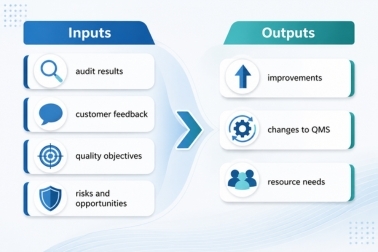
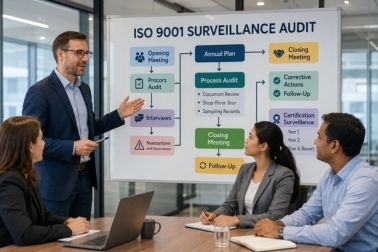
TopCertifier supports the full certification journey — gap analysis, risk assessment, documentation and procedure development, staff training, internal audits, and full audit preparation — delivered on-site across Jurong Island, Seletar Aerospace Park, the PSA port network, Tuas, and central Singapore, or remotely for businesses elsewhere in the region.
Evidence-First Methodology
TopCertifier SingaporeOur structured, evidence-first approach is designed to take your QMS from gap analysis to a successful certification audit without unnecessary rework, because the system genuinely reflects how your business operates — not a binder assembled for the week the auditor visits.
Globally Recognized, Locally Accredited
Every certification TopCertifier's clients receive is issued by a body accredited under the Singapore Accreditation Council (SAC) or an equivalent international accreditation body such as UKAS, ANAB, or JAS-ANZ — including certification bodies like SGS, TÜV SÜD, Bureau Veritas, BSI, and DNV. This chain of accreditation is what makes a Singapore-issued ISO 9001 certificate hold real weight internationally: SAC accredits the certifier, and the certifier certifies your business, so buyers and regulators anywhere in the world — from a Jurong Island refinery's own supplier audit to an airline's MRO vendor panel — can verify the credential is genuine rather than a logo with no accreditation behind it.